
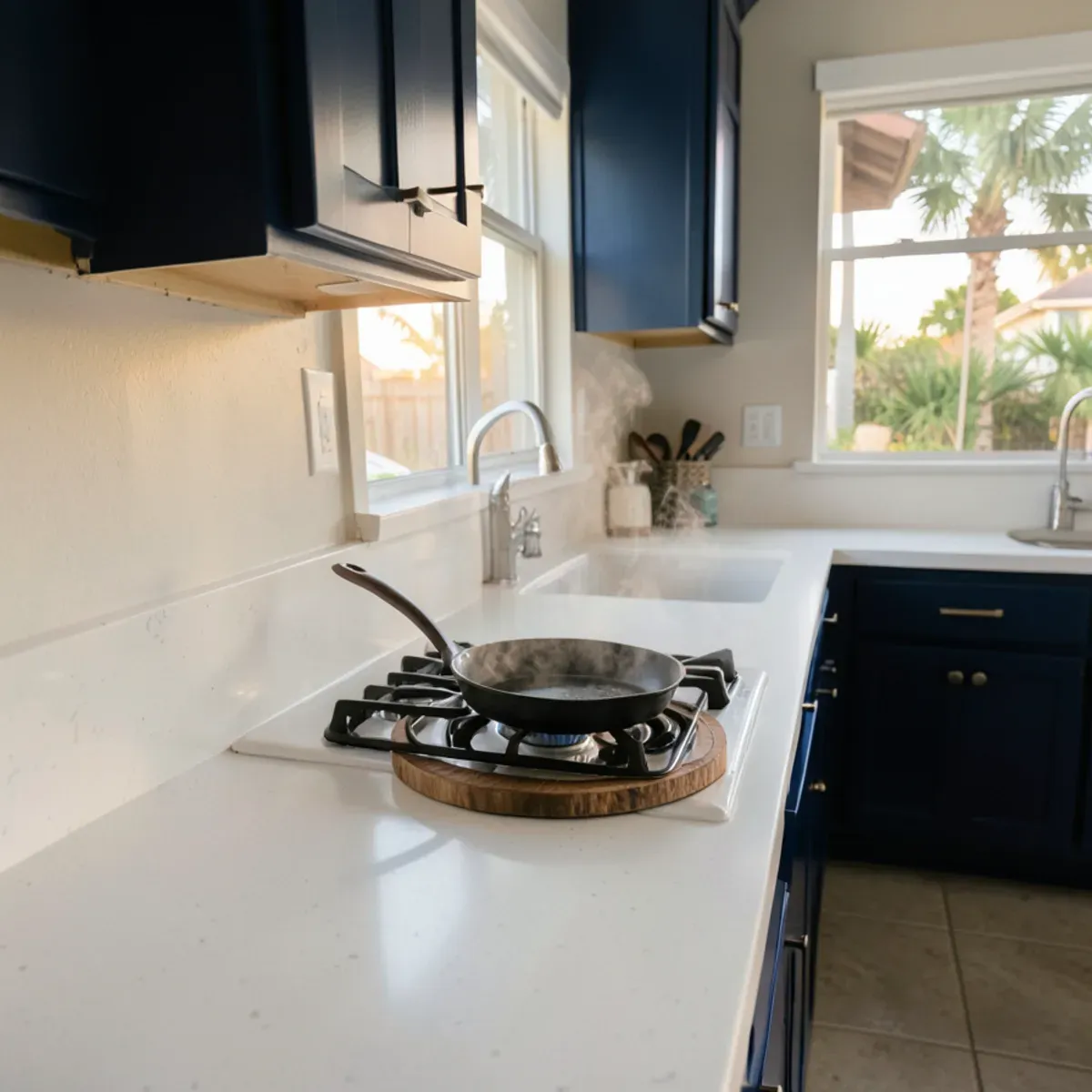
Quartz handles warm dishes and coffee mugs, but not a pan straight off the burner. Engineered quartz is mostly ground stone held together by polymer resin, and that resin can scorch, discolor or crack from sudden or sustained heat. Trivets and hot pads are simply part of owning it.
People often assume quartz behaves like granite because both are called stone. The difference is the binder. Granite formed under enormous heat deep in the earth; quartz is made in a factory, and its resin has limits that granite does not.
We won't quote you a temperature that quartz can take. Manufacturers word their guidance differently, and the damage depends as much on how long the heat sits and how fast it arrives as on how hot the pan is. What we can do is explain where heat marks come from and how to avoid them.
Why Does Quartz React to Heat When Granite Doesn't?
A quartz slab is mostly crushed mineral, with a smaller share of resin and pigment holding it together. The mineral is tough; the resin is closer to a hard plastic. Concentrated heat softens or burns the resin at the surface, which shows as a ring, a yellow or brown cast, or a dull spot that no cleaner will lift.
The effect is most visible on light colors. That is worth knowing if you are considering white quartz countertops, where a faint scorch ring stands out against the plain background in a way it never would on a dark speckled slab.
Want a straight answer for your kitchen? Call the shop.
Free in-home estimates · Mon–Fri 7:00–4:30 · weekend estimates by appointment
Which Kinds of Heat Cause the Damage?
The obvious culprit is the skillet, but plenty of scorch marks come from appliances that sit warm for hours:
- Pots and pans moved straight from the burner or oven, especially cast iron, which holds heat a long time
- Slow cookers, electric pressure cookers and rice cookers whose bases stay warm through a whole cycle
- Air fryers, toaster ovens and countertop griddles that vent heat downward or out the back
- Baking sheets set down to cool beside the range
- Curling irons and flat irons laid on a quartz vanity top in the bathroom
- Thermal shock: a very hot pot set near a cutout or seam, where the stone is narrowest and stress concentrates
Sunlight is a separate issue. Strong UV through a slider can slowly yellow some quartz colors over years, which is why most manufacturers do not support outdoor use.
What Does Heat Damage on Quartz Look Like, and Can It Be Undone?
| What you see | What happened | Typical outcome |
|---|---|---|
| Pale ring or cloudy circle | Resin at the surface softened | Often permanent; may fade slightly |
| Yellow or brown discoloration | Resin scorched | Permanent; cleaners will not lift it |
| Dull patch | Surface polish lost to heat | Sometimes improved by professional refinishing |
| Hairline crack near a cutout | Thermal shock or stress | Usually means replacing that section |
Many quartz manufacturers exclude heat damage from their product warranties, so read the care sheet that comes with your slab. Prevention is far cheaper than any fix.
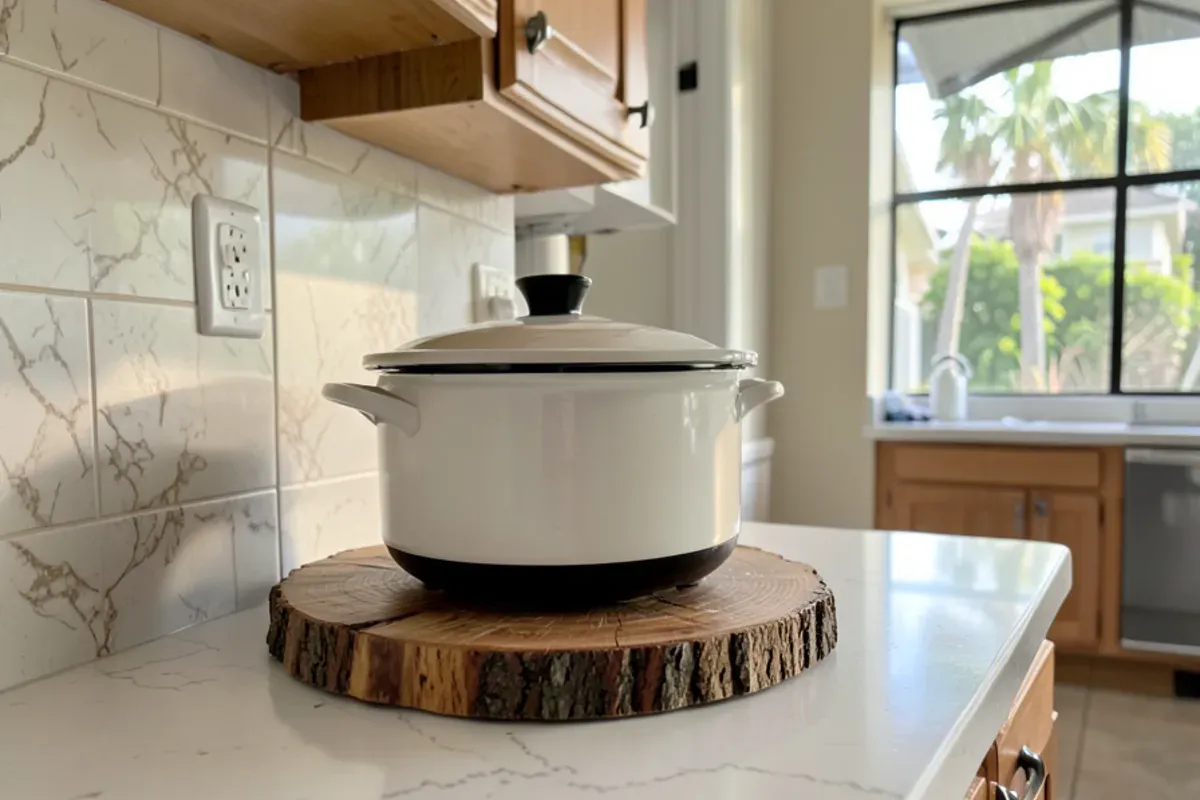
A Hot Pan Just Touched the Quartz. Now What?
What you do in the next few minutes will not reverse a scorch, but it can keep a small mark from becoming a bigger one.
- Lift the pan straight up instead of sliding it, so the hot base does not drag across more stone
- Let the spot cool on its own; ice or cold water on hot stone adds a second, sudden temperature change
- Once it is cool to the touch, wash the area with mild soap and water and dry it
- Look at the spot from a low angle with a light behind it, which shows rings and dull patches clearly
- Skip the sandpaper, magic erasers and strong chemicals; home fixes usually dull a wider area than the mark
- If you see a hairline line near a cutout or seam, have someone look at it before it is loaded again
Often the spot looks worse in the first hour than it does the next day. Give it a day before deciding whether it is a mark you can live with.
Do Some Quartz Colors Hide Heat Marks Better?
No quartz color is immune, but the same mark reads differently depending on the background. On whites and pale creams, scorched resin shows as a yellow or brown cast. On charcoal, black and deep blue slabs, the more common sign is a pale, cloudy ring where the polish changed. Busy speckled and mid-tone patterns hide either kind best.
That is worth weighing for the counter run beside the range rather than the whole kitchen. A bright white island across the room sees far less heat than the short runs on either side of the cooktop, so the color choice can follow the risk.
Habits and Layout Choices That Protect a Quartz Kitchen
Most heat damage happens in the same two places: beside the cooktop and on the island directly behind it. Plan for those spots and the rest of the kitchen takes care of itself.
- Keep a trivet or two permanently on the counter beside the range, so the safe landing spot is always within reach
- Park slow cookers and air fryers on a wooden board or silicone mat instead of bare quartz
- Leave space between the cooktop cutout and the edge of the counter so hot pans have somewhere to go
- Consider granite or porcelain for the range run and quartz for the island if you cook hot and often
- Keep a heat-resistant mat on the bathroom vanity for styling tools
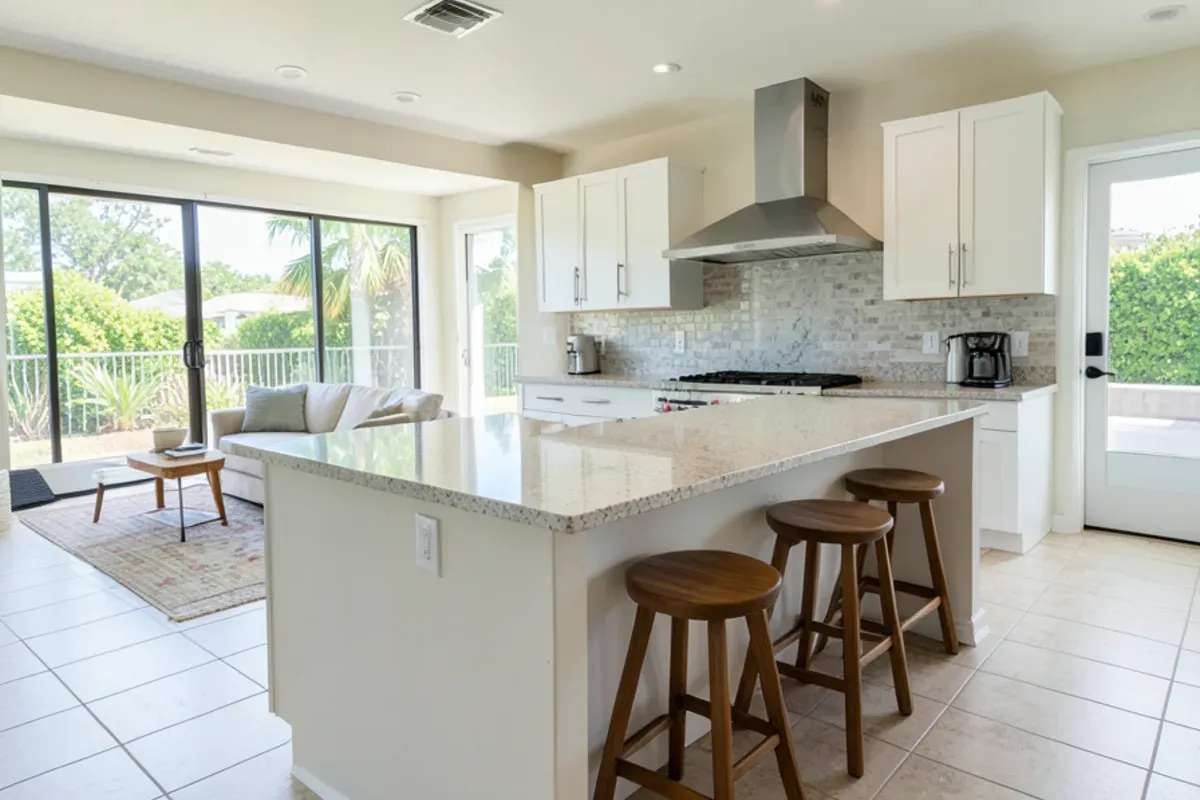
In the open-plan layouts common in Port St. Lucie, the island usually sits a single step behind the range, which makes it the default spot for a sizzling pan. A built-in trivet zone or a different material on that one run solves it without giving up the look.
Shop Talk: Where We Find Heat Marks
When we template a kitchen that is replacing older quartz, the scorch rings are almost always on the island side facing the cooktop or on the short run beside the oven. Rarely anywhere else. That tells us the material isn't fragile; the habit of the quick set-down is the problem.
On our side, we cut cooktop and sink openings with rounded inside corners rather than sharp ones, because a radius spreads stress that a square corner concentrates. We also walk you through care at the hand-off so the trivet habit starts on day one. Our quartz countertops in Fort Pierce page covers the other everyday traits, from sealing to seams.
Seam placement is the other heat decision we make for you. A seam is filled with color-matched epoxy, which is also a resin, so we try to keep seams out of the landing zone beside the cooktop and away from the spot where the oven door opens. At the template we ask which side you set pans on. Keeping that side wide and seam-free costs nothing extra in most layouts and removes the weakest point from the hottest place.
Questions We Hear About This
Can I put a hot coffee mug or a plate of food on quartz?
Yes. A mug of coffee, a dinner plate or a casserole dish that has cooled for a few minutes will not harm quartz. The risk comes from cookware and appliances that are much hotter or that sit in one place for a long time. If you would hesitate to hold it with a bare hand, put a trivet under it.
Is a quartz vanity top safe around a curling iron?
Not without protection. Styling tools get hot enough to mark resin if laid directly on the counter, and the damage tends to be a small dark line that is hard to hide. A silicone heat mat or a wall-mounted holder solves it. We often suggest that to customers choosing quartz for a bathroom vanity.
If I scorch my quartz, is the whole countertop ruined?
Usually not. A mark is cosmetic, and many people live with a small one. A deep scorch or a crack near a cutout may mean replacing that section, and matching an older color exactly can be difficult. That is the strongest argument for keeping trivets beside the range from the day the tops go in.
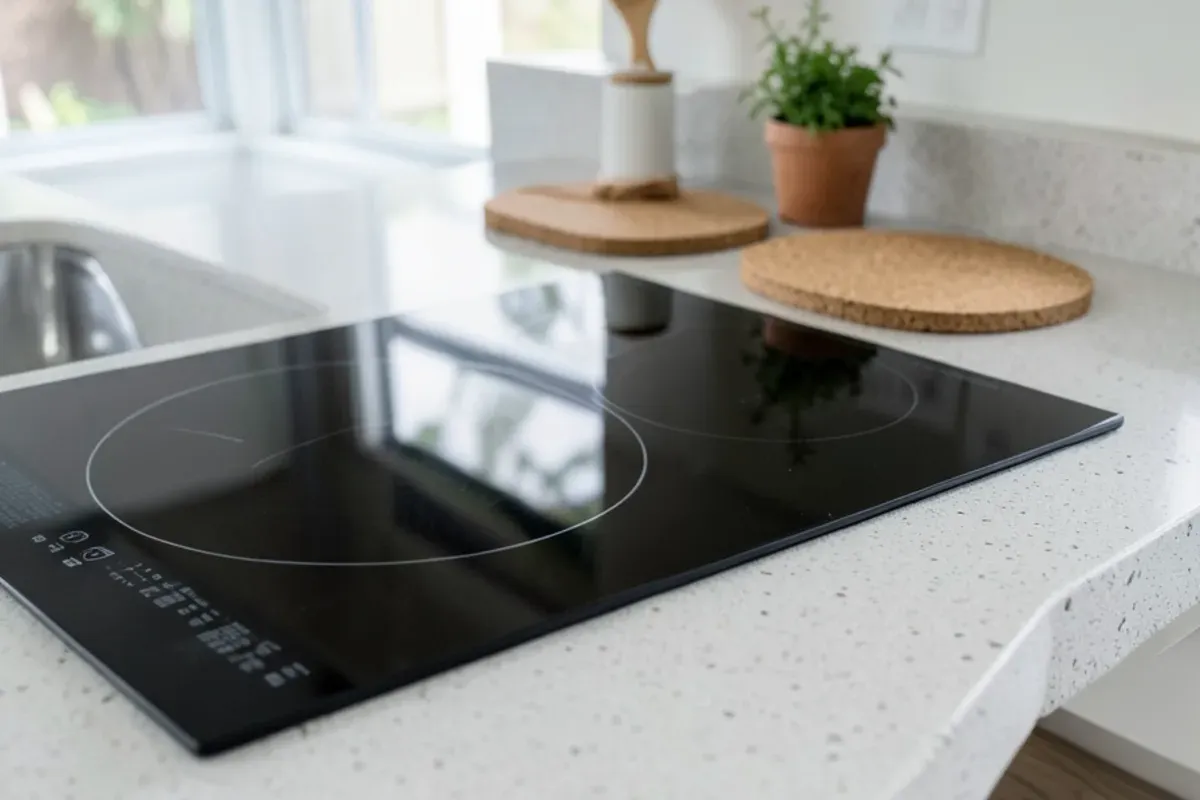
Is quartz safer next to an induction cooktop than a gas range?
Somewhat, around the cooktop itself. Induction heats the pan rather than the burner, so the glass and the stone beside it stay cooler than a gas grate does. The pan, though, is just as hot when you move it, so the set-down risk does not change. Either way, the cutout follows the cooktop maker's installation clearances, which we check against the unit on site.
The Bottom Line
Quartz is a practical, low-maintenance surface as long as you respect the resin. Trivets near the range, boards under countertop appliances and a little thought about layout are all it takes.
Weighing quartz against granite for a kitchen in Port St. Lucie or Palm City? Give our shop a call. On a free visit we look at where you cook and help you place each material where it performs.