
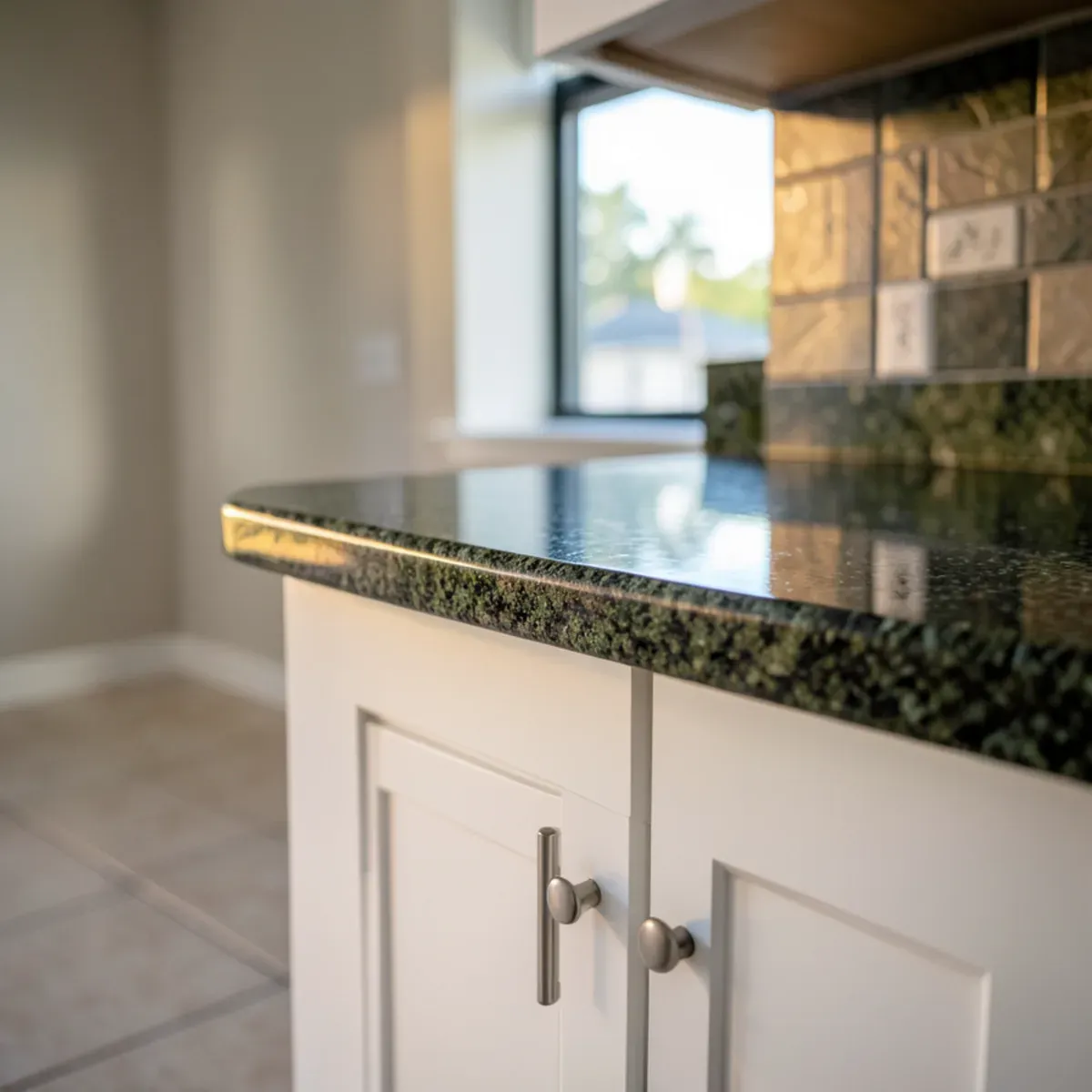
The common countertop edge profiles are eased (a softened square), bevel, half bullnose, full bullnose, ogee and mitered. Eased and half bullnose are the most practical for busy kitchens because they resist chips and wipe clean; ogee and mitered edges add detail or apparent thickness but cost more because they take more shaping, more passes or extra stone.
The edge is the part of a countertop you touch most and notice least, until it chips. It sets the style of the kitchen, decides how easily crumbs and spills wipe off, and changes the quote more than most people expect.
Here is what each profile looks like, how it holds up in daily use, which materials suit which edges, and how edges are usually priced.
What Does Each Countertop Edge Look Like?
| Profile | Shape | Style | Daily wear | Relative cost |
|---|---|---|---|---|
| Eased | Square with lightly softened corners | Clean, modern, works anywhere | Good chip resistance | Lowest; often standard |
| Bevel | Angled cut along the top corner | Crisp, slightly tailored | Good; the angle sheds knocks | Low to moderate |
| Half bullnose | Top corner rounded, bottom square | Soft, traditional or coastal | Very good; kind to hips and kids | Moderate |
| Full bullnose | Rounded top and bottom | Soft, classic | Good; drips can run under | Moderate |
| Ogee | S-shaped curve with a step | Formal, traditional | Groove collects crumbs | Higher |
| Mitered | Strip joined at 45 degrees for a thick look | Heavy, modern slab look | Good, but a corner seam line shows | Highest; uses extra stone |
Want a straight answer for your kitchen? Call the shop.
Free in-home estimates · Mon–Fri 7:00–4:30 · weekend estimates by appointment
How Do Edges Wear in a Real Kitchen?
Chips happen in predictable places: the corner beside the dishwasher, the stretch in front of the sink where heavy pots land, and island corners at hip height. Sharp square edges chip there first. A small radius or a bevel spreads the impact and holds up better.
- Ogee and other stepped profiles trap flour, crumbs and cleaning residue in the groove
- A full bullnose lets spills curl under the edge and drip onto cabinet doors
- Mitered edges look massive but show a fine line where the strip meets the top
- Rounded edges are friendlier in homes with small children or older adults
Which Edges Suit Which Countertop Materials?
Granite and quartz take nearly any profile. Marble is softer and shows chips on sharp corners, so eased and bullnose profiles suit it. Quartzite can be shaped into any edge but takes longer because of its hardness. Porcelain is the exception: on printed slabs, shaping would cut through the pattern, so it is usually limited to a small eased edge or a mitered build-up.
Edges are shaped and polished in the shop after the pieces are cut. Our countertop fabrication page explains that step and the profiles we can run on each material.
Mitered or Laminated: Two Ways to Build a Thicker Edge
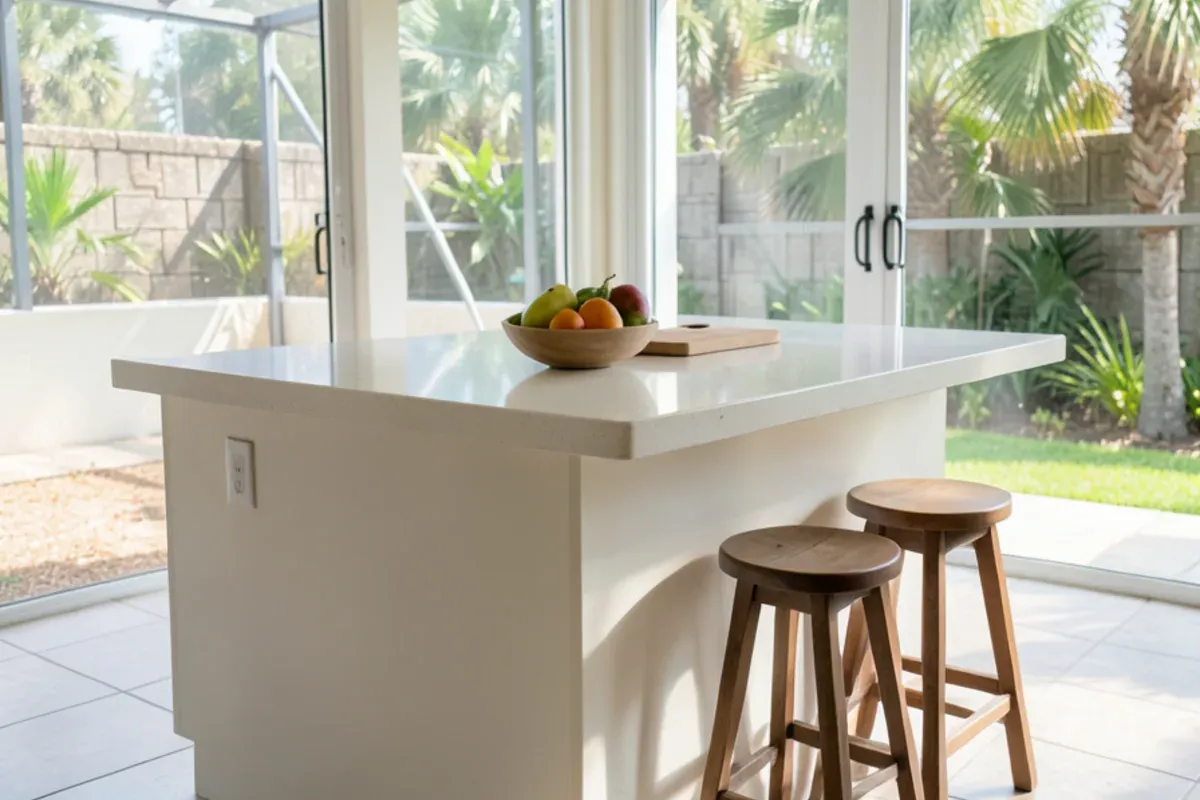
Slab thickness sets the starting point. A 3 cm slab usually sits straight on the cabinets and can take any single profile. A 2 cm slab looks slimmer, and when owners want it to read heavier, the fabricator adds a strip of stone under the front edge. There are two ways to attach that strip, and they look quite different.
| Method | How it is made | What you see | Suits |
|---|---|---|---|
| Laminated (stacked) | A strip glued flat under the front edge, then the combined edge is shaped | A horizontal joint line along the face of the edge | Traditional stacked profiles such as a double bullnose or ogee over a bullnose |
| Mitered | Top and strip both cut at 45 degrees and joined at the corner | The pattern wraps over the corner; the joint sits on the arris | Modern square looks and veined quartz where the pattern should continue |
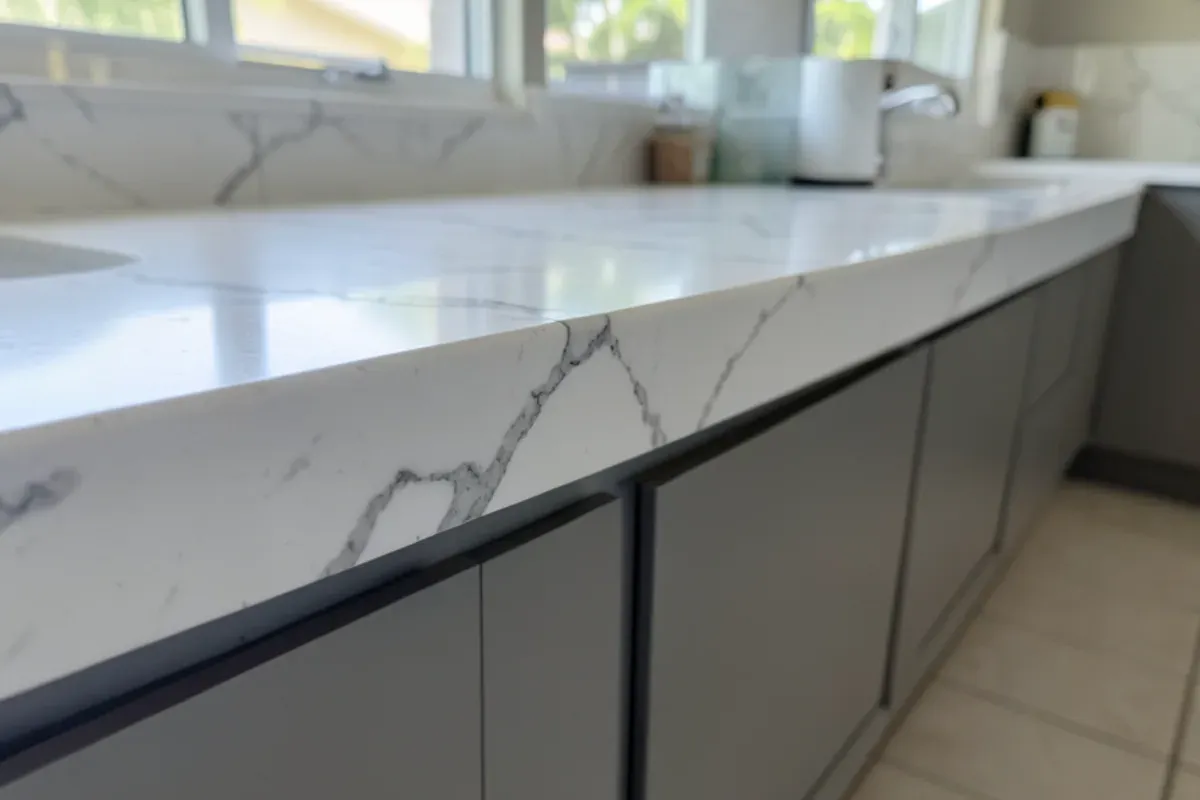
A laminated edge is the older method and is forgiving on busy granite, where the joint line disappears into the speckle. A miter takes more cutting and careful matching, but on a veined slab it is the only way to make the vein flow down the front, which is why it shows up on islands meant to look like one solid block.
What Does an Edge Profile Add to the Price?
Fabricators commonly price decorative edges by the linear foot of exposed edge, not by square foot of counter. That means an island with seating on three sides adds far more edge than a galley run against two walls. A simple eased edge is often part of the base price; profiles that need more passes or more stone cost more.
- Count the exposed edge: island perimeter, peninsula ends, bar tops
- Pick one profile for the perimeter and decide whether the island gets something different
- Ask for the edge to be a separate line on the written estimate
- Compare quotes on the same profile and the same edge length
A mitered edge costs the most because the fabricator cuts extra strips from the slab, joins them at 45 degrees and blends the seam. It can also change how many slabs you need.
Edges that are easy to forget when you count
- Both sides of a slide-in range opening, which are exposed and get the same profile as the front
- The end of a run beside the refrigerator or at a doorway
- The inside of an undermount sink cutout, which is polished rather than profiled
- A peninsula's return end and any short step-down to a desk or bar section
Matching the Edge to Older and Newer Homes
In older block homes in Fort Pierce, with raised-panel or shaker cabinets, a half bullnose or bevel looks at home and is forgiving in a well-used kitchen. Newer builds in Port St. Lucie with flat-panel cabinets lean toward an eased edge or a mitered look that makes a 2 cm or 3 cm top read as a thick slab.
At the Edge-Polishing Bench: Advice From Our Shop
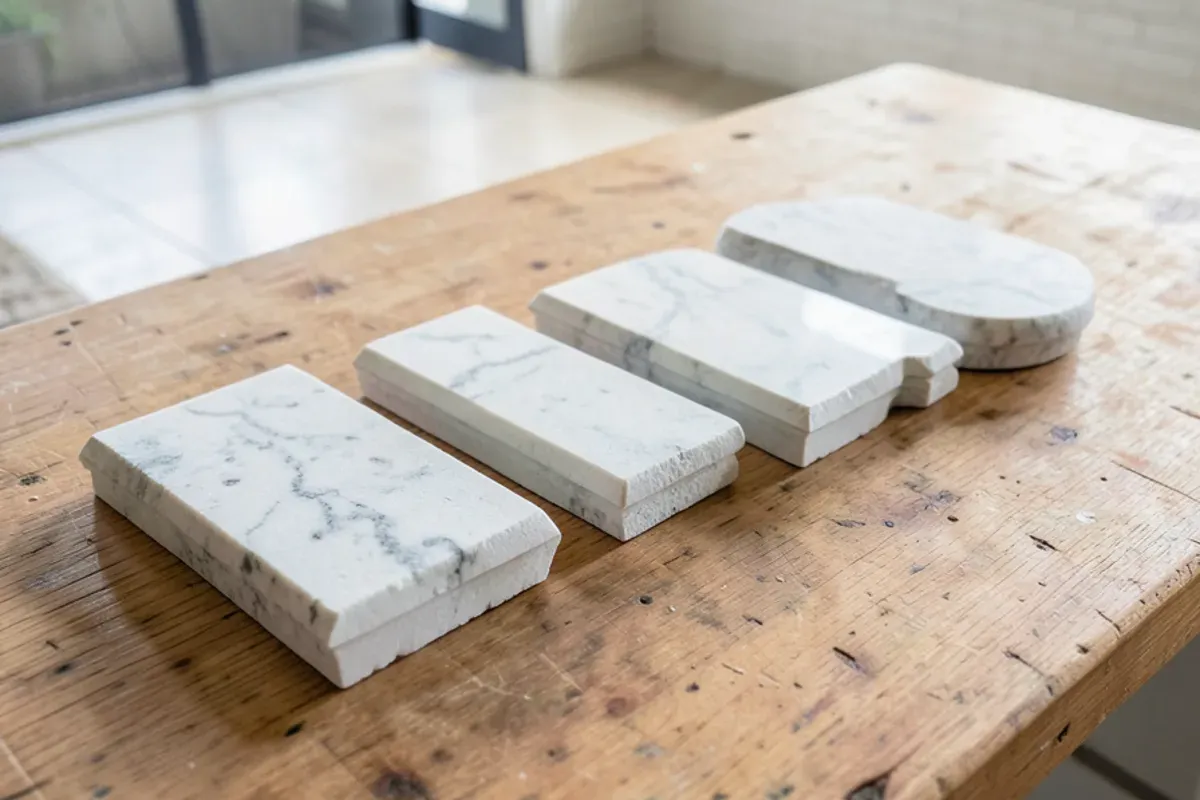
When people ask us which edge to choose, we hold two samples to the cabinet door rather than describe them. The difference between an eased edge and a half bullnose is easier to feel with a hand than to explain, and the cabinet style usually makes the answer obvious.
We also point out where an edge will take abuse. A sharp corner beside the dishwasher is where we see the most chips on older tops, and softening that corner a little costs far less than a chip repair later.
One trade-off people rarely hear about: an edge can only be changed by removing stone. A square edge can later be softened or rounded, but a bullnose can never go back to a crisp square without losing depth. Detailed profiles are also harder to fix when they do chip, because a filled spot in an ogee groove is tricky to blend, while a chip on a plain eased edge is simpler to fill and polish out. If you are torn between two profiles, the simpler one keeps more options open.
Questions We Hear About This
Which countertop edge chips the least?
Rounded and angled profiles, mainly the half bullnose and the bevel, resist chips better than a crisp square because there is no sharp corner to catch an impact. An eased edge, which is square with lightly softened corners, is a good middle ground. In a busy kitchen with heavy pots, avoid knife-sharp corners, especially near the sink and dishwasher.
Can the island have a different edge than the perimeter?
Yes. Many kitchens pair a simple eased edge on the perimeter with a more decorative or thicker-looking mitered edge on the island, which acts as the room's centerpiece. The two just need to share the same material and look intentional together. Ask for each edge to be priced separately on the written estimate so you can compare.
Does a mitered edge show a seam?
A fine line, yes. A mitered edge is a separate strip of stone joined to the top at 45 degrees, and the joint is filled with color-matched epoxy and polished. On busy granite and veined quartz, a careful fabricator matches the pattern so the line nearly disappears. On solid colors it is easier to see up close.
Which edge is safest around small children and older adults?
A half or full bullnose, because there is no hard corner at head or hip height. Pair it with a rounded corner, called a radius, on the island and peninsula ends; the profile softens the edge, while the radius softens the point where two edges meet. The pairing suits a home with toddlers as well as one where grandparents live and grandchildren visit. Both details are marked on the template.
The Bottom Line
Pick an edge for how you live in the kitchen first and for looks second. Eased and half bullnose cover most busy homes, bevel adds a crisp line, and ogee or mitered edges are worth the extra cost when the counter is meant to be a feature.
Material, edge and seam planning come together on our countertop installation page. When we visit to quote, there is no charge, and you can hold each edge sample against your own cabinet doors.