
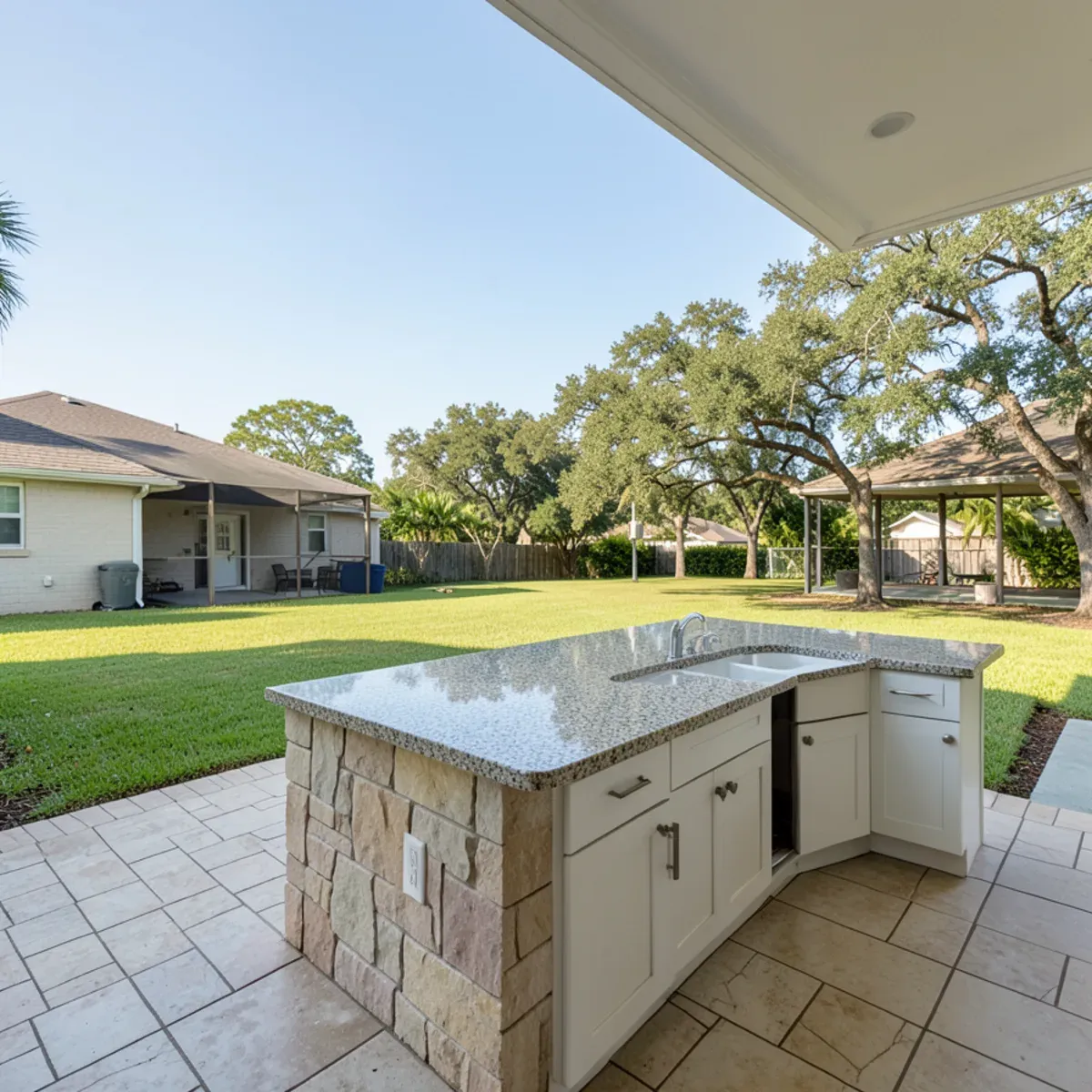
For most Florida outdoor kitchens, granite is the more forgiving all-round choice: it's thick, tough at the edges and holds its color in the sun, though it needs periodic sealing. Porcelain is the lower-maintenance choice: UV-stable, stain-resistant and usually sealer-free, but thinner and more prone to edge chips, so it suits modern designs where corners are protected.
Both materials belong outdoors, and either one beats quartz in Florida sun. The choice between them comes down to how the kitchen is used, how much sun it gets and how much upkeep you're willing to do.
Granite vs Porcelain at a Glance
| Factor | Granite | Porcelain slab |
|---|---|---|
| What it is | Natural stone quarried in slabs | Fired clay and minerals pressed into thin slabs |
| Typical thickness | 3 cm common outdoors | Thinner; edges often mitered to look thicker |
| Color in UV | Stable | Stable; color is fired in |
| Sealing | Periodic, checked with a water-drop test | Usually none |
| Stains | Resists when sealed; grease can darken light colors | Very stain-resistant |
| Edge chips | Tough; small chips are rare | More prone at corners and exposed edges |
| Looks | Natural patterns; every slab differs | Wide range, including marble and concrete looks |
Neither column wins outright. Granite gives up some maintenance in exchange for toughness; porcelain does the reverse.
Want a straight answer for your kitchen? Call the shop.
Free in-home estimates · Mon–Fri 7:00–4:30 · weekend estimates by appointment
Which One Gets Hotter in Direct Sun?
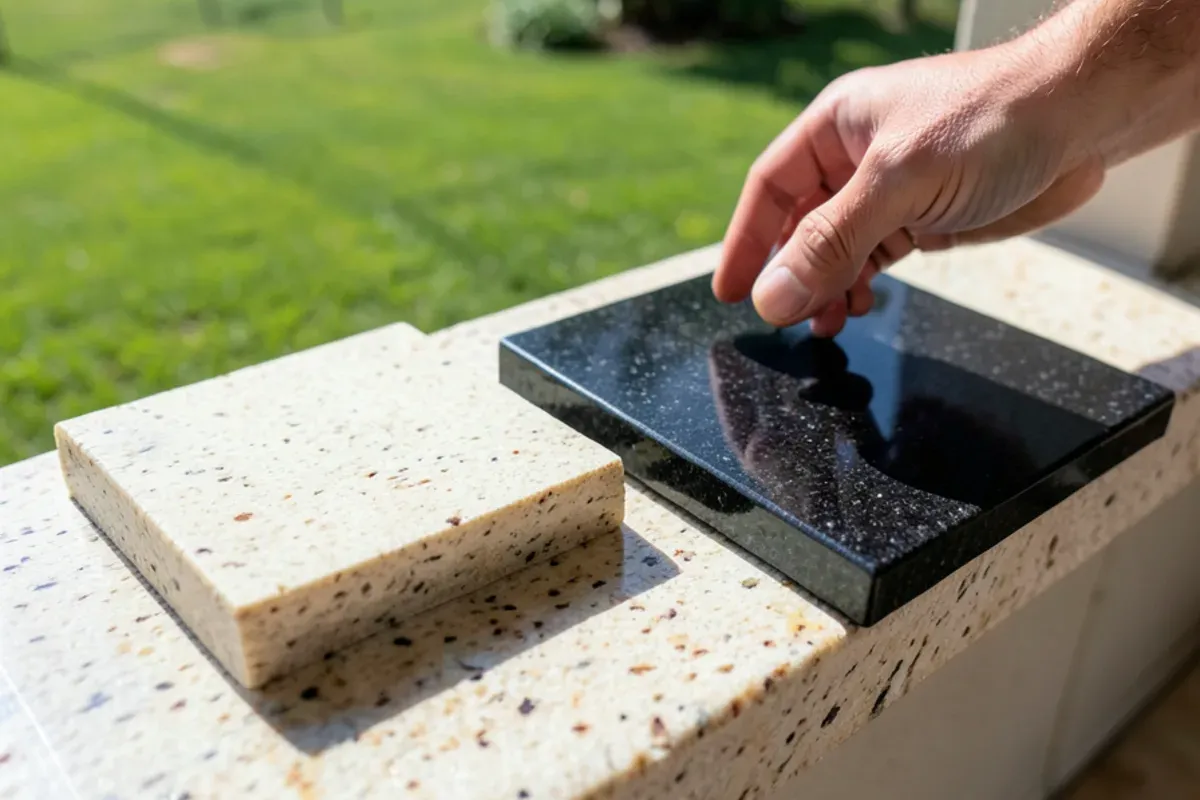
Color matters more than the material. A black or deep brown granite and a dark charcoal porcelain both absorb a lot of sunlight and can be uncomfortable to touch on a summer afternoon. A pale granite or a white porcelain stays noticeably cooler. Finish plays a part too: honed and leathered granite or matte porcelain cut glare compared with a high polish.
Open sites feel this most. On the large rural lots in Jupiter Farms, where an outdoor kitchen may sit in open sun with no roof at all, we'd lean toward light colors in either material, plus shade over any seating.
Fading, Stains and Sealing in Florida Humidity
Neither material fades the way resin-bound quartz can. Granite's color formed in the earth, and porcelain's is fired in a kiln. The difference is porosity. Granite has tiny pores that a sealer fills, and outdoors, where rain and humidity are constant, you'll check that sealer more often than indoors. Grill grease left overnight is the stain we see most on light granite.
Porcelain absorbs almost nothing, so grease, wine and sunscreen wipe off without a sealer. One thing to know: on many porcelain slabs the pattern is applied to the surface, and the body underneath can look different at a cut edge. That's why porcelain edges are usually mitered rather than left showing the raw cut.
How Are Granite and Porcelain Fabricated Differently?
The two materials behave differently on the cutting table, and that shapes both the price and the finished look.
Granite
Outdoor granite usually arrives as a 3 cm slab, and the edge profile is shaped from the solid stone, so an eased, bevel or bullnose edge carries the same pattern as the top. The thickness also carries the narrow strips beside a grill or sink opening without extra help.
Porcelain
Porcelain is thinner and harder, and it is cut slowly to avoid chipping. Inside corners of cutouts are rounded rather than square, because a sharp corner is where a crack starts. The front edge is often built up with a mitered strip so the top reads thicker, and the slab needs full, flat support across the whole base.
What Does Each Take to Maintain Through a Florida Year?
| Season | Granite | Porcelain |
|---|---|---|
| Spring, before the rains | Water-drop test; reseal if the stone darkens | Rinse off pollen; check mitered edges for gaps |
| Summer rain and heavy grilling | Wipe grease the same day; rinse after storms | Wipe and rinse; no sealer needed |
| Hurricane season | Clear the top; check seams and overhang brackets | Clear the top; look for chipped corners after a storm |
| Winter, drier months | Mild soap clean; a second water-drop test | Mild soap clean; look over the cutout corners |
Over a year, granite asks for roughly an afternoon of sealing plus the habit of wiping grease. Porcelain asks for care at its edges and very little else.
Chips, Edges and Cutouts: Where Porcelain Needs Care
Porcelain's thinness is its main weakness outdoors. Points to plan for:
- Exposed corners where stools, coolers and grill tools can knock them
- Narrow strips around large grill and burner openings, which need careful fabrication and full support
- Mitered edges, which look sharp but rely on a precise joint along the front
- Full support underneath, since thin slabs shouldn't span gaps the way 3 cm granite can
Granite at 3 cm is more forgiving of all of that. If the outdoor kitchen is a busy family space, that forgiveness counts for a lot.
Which Fits Your Outdoor Kitchen or Bar?
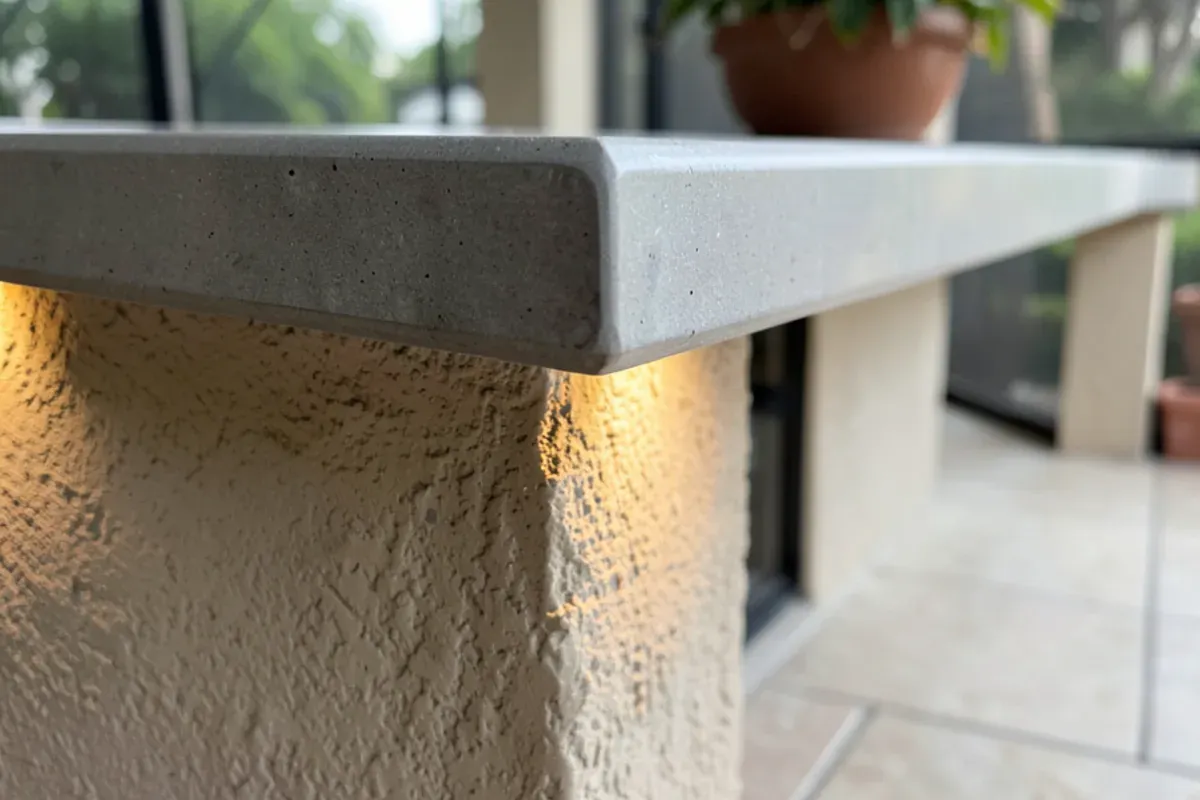
Lean toward granite if the kitchen gets heavy use, kids and pets are around, the grill opening is large, or you want natural stone that hides wear. Lean toward porcelain if you want a clean modern or marble look, prefer no sealing, and the layout keeps corners away from traffic.
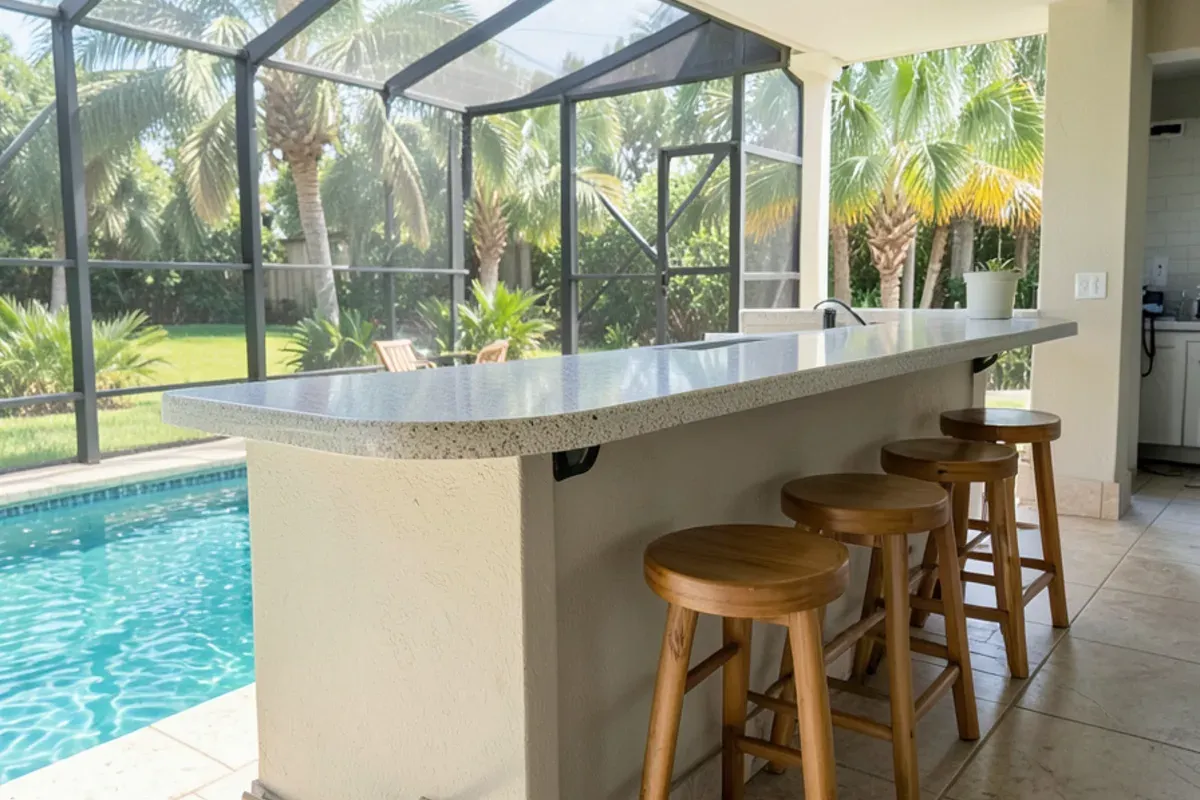
Bars are a good example. A pool bar with stools along a long edge takes knocks every weekend, which favors granite or a porcelain with a rounded, well-protected edge. Our outdoor bar countertops page covers bar heights and overhangs, the porcelain countertops page goes deeper into that material, and our outdoor kitchen countertops overview compares every option.
From Our Shop: Edges Usually Decide It
When we bring granite and porcelain samples to an outdoor kitchen, people start by comparing color. The more useful conversation is about edges: where people sit, where coolers get set down and which corners sit next to a walkway. Those are the spots that tell you whether a thinner material will be happy.
On a layout with protected corners and a clean modern design, porcelain works well. On a busy island by the pool, we usually point people toward granite in a lighter color, which gives them toughness without the heat of a dark stone.
Think about the future, too. Porcelain is made in a factory, so a second slab for a later bar extension tends to match closely. Granite changes in color and movement between quarry lots, so if you might extend the kitchen in a few years, ask whether extra stone from the same lot can be set aside now.
Questions We Hear About This
Is porcelain more expensive than granite for an outdoor kitchen?
It depends on the specific slab and the edges. Many granites and porcelains fall in similar ranges, but porcelain often needs mitered edges and careful cutout work, which adds fabrication time. A detailed quote listing each edge and opening is the only way to compare the two fairly for your layout, so we're happy to price both.
Which is better next to a pool?
Both handle splashed pool water. Porcelain shrugs off chlorine and sunscreen without sealing, while sealed granite resists them well and is tougher at the edges where wet hands and kids grab. Near a pool in full sun, choose a lighter color in either material so the top stays comfortable to sit at.
Does porcelain fade in Florida sun?
No, not the way resin-bound surfaces can. Porcelain's color is fired in at high heat, so UV light doesn't break it down. What can change is the look at a cut or chipped edge, where the body underneath may differ from the printed surface. That's why we miter exposed edges and, where the layout allows, keep corners out of traffic.
How thick should an outdoor granite top be?
For most outdoor islands and bars, 3 cm. The extra thickness carries the narrow strips around a grill opening, spans a typical 10- to 12-inch seating overhang without brackets, and gives a sturdier edge against bumps. Thinner 2 cm granite can work on a fully supported prep counter, but it usually needs a built-up edge and leaves less margin around big cutouts.
Can porcelain go on an existing outdoor island?
Often, if the base is flat and fully supported. Thin porcelain needs continuous support across the top of the island, so an older base with gaps or uneven block may need a flat substrate added first. We check that at the visit, along with whether the existing grill opening suits a thinner material.
The Bottom Line
Granite and porcelain are both sound outdoor choices in Florida. Pick granite for toughness and forgiveness, porcelain for low maintenance and a modern look, and choose a light color either way if the kitchen sits in open sun.
If you're deciding between them for a home in Palm City or nearby, call us and we'll bring both to see side by side on your patio.