
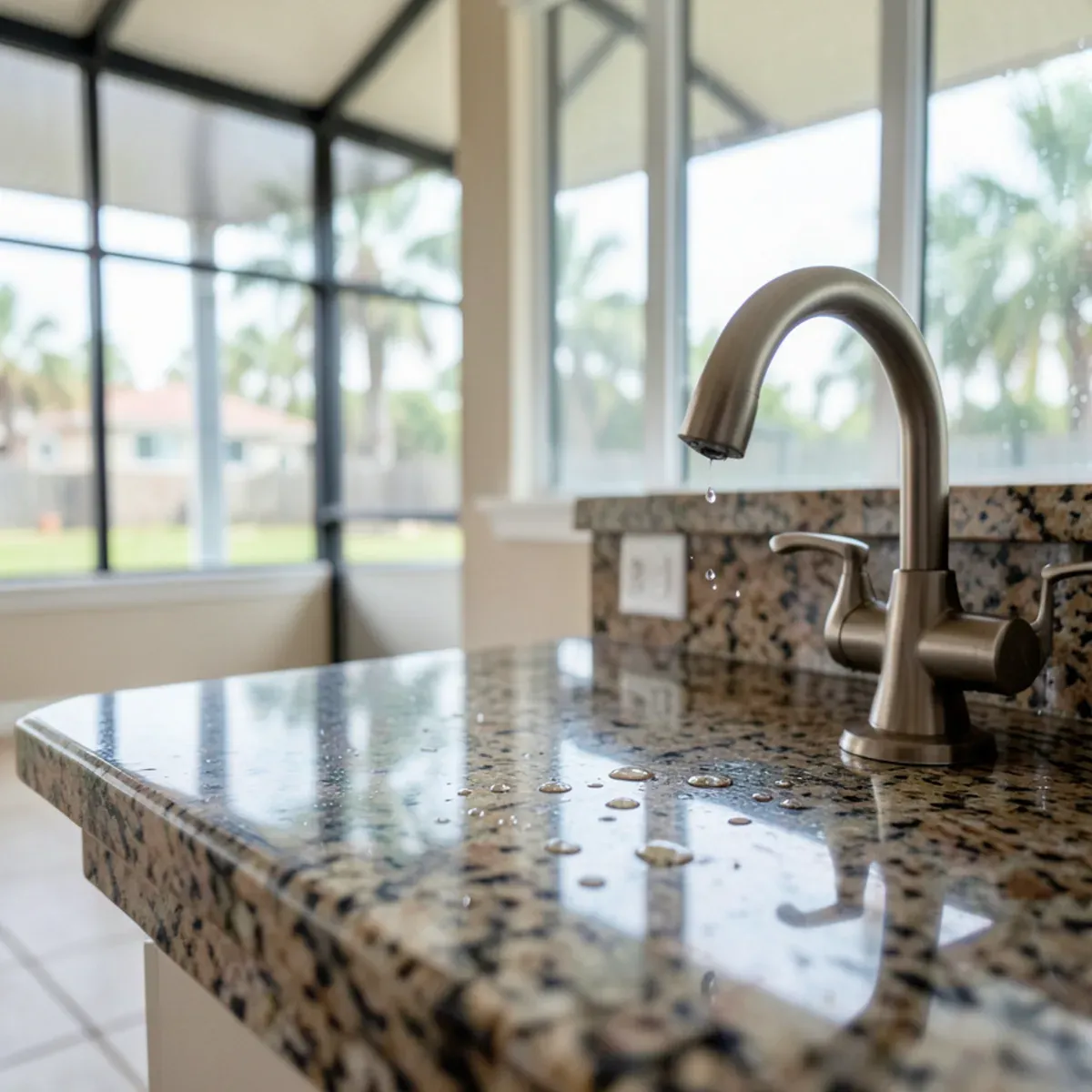
Most granite kitchen counters need resealing somewhere between once a year and once every few years, and the reliable way to know is a water-drop test: if a few drops darken the stone within about 15 minutes, it is time. Light, porous granites around a busy sink usually need it sooner; dense dark granites may barely absorb sealer at all.
You will find confident answers online ranging from every six months to never. They are all true for some granite and wrong for others, because the stone's porosity and how the counter is used matter far more than the calendar. A test takes a few minutes and tells you what your particular slab needs.
Here is how to run the test, how Florida conditions really affect sealer, and which products to use and avoid.
How Do You Do the Water-Drop Test on Granite?
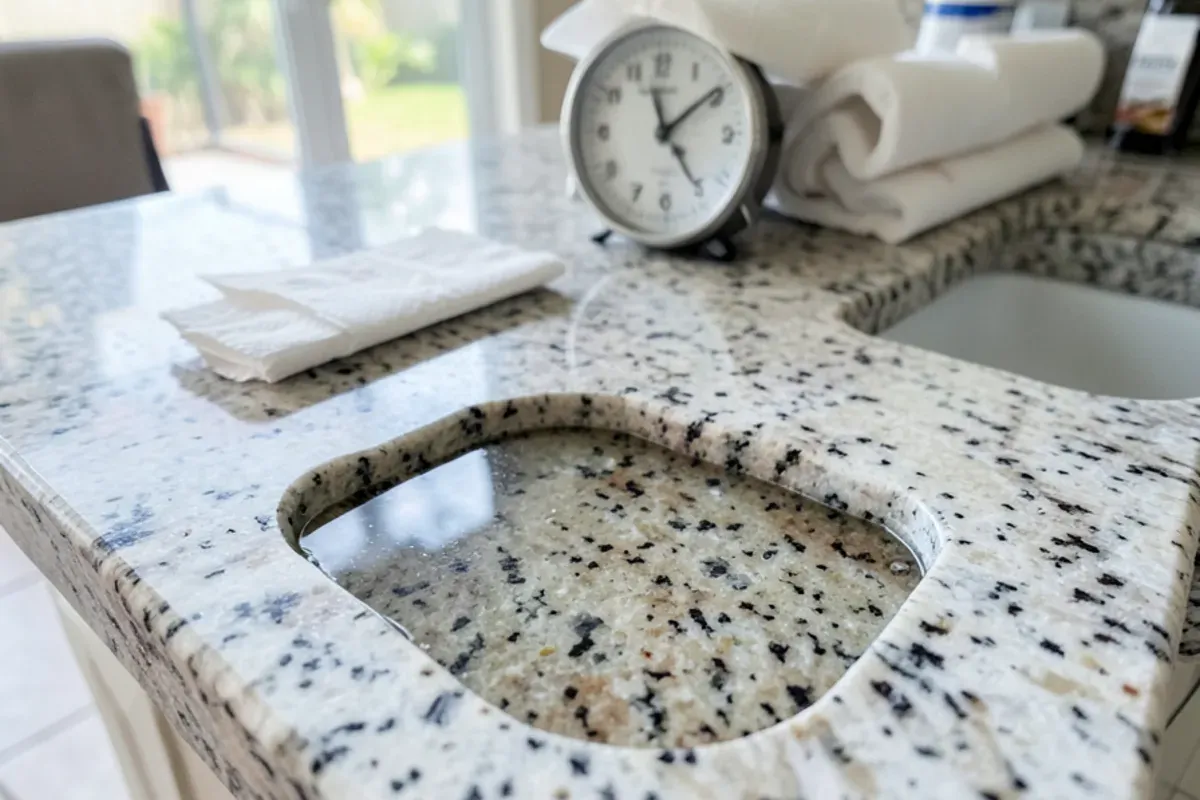
- Pick three spots: beside the sink, near the cooktop, and somewhere rarely used as a comparison.
- Wipe each spot clean with water and let it dry completely.
- Place a small puddle of water, about the size of a coin, on each spot.
- Wait about 15 minutes, then blot the water away.
- If the stone under the puddle is darker than the surrounding granite, water is soaking in and that area needs sealing. If it looks the same, the seal is still working.
A dark ring that fades as it dries is normal absorption, not damage. If the spot near the sink darkens quickly while the rarely used spot does not, the sealer has worn where the counter works hardest; you may only need to reseal that area.
Want a straight answer for your kitchen? Call the shop.
Free in-home estimates · Mon–Fri 7:00–4:30 · weekend estimates by appointment
Does Florida Humidity Wear Out Granite Sealer?
Not directly. Indoor air moisture does not strip a penetrating sealer out of the stone. What wears it down is what touches the counter: harsh cleaners, standing water around the faucet, cooking oils and daily scrubbing. A kitchen that is cleaned with an all-purpose spray every day will need resealing sooner than one cleaned with soap and water.
Weather matters more outside. ZIP 34945 near Fort Pierce gets about 54.7 inches of rain annually, compared with roughly 38 inches for the U.S. as a whole (Bestplaces), and an outdoor kitchen or lanai bar takes rain, pool water and sun. Those tops are worth testing twice a year.
How Often Should Different Granite Counters Be Checked?
| Situation | What the test usually shows | Test it |
|---|---|---|
| Light, porous granite at a busy kitchen sink | Darkens soonest | Every 3 to 6 months |
| Mid-tone speckled granite in a kitchen | Absorbs slowly | Every 6 to 12 months |
| Dense black or dark green granite | Often absorbs almost nothing | Once a year |
| Honed or leathered finish | Absorbs more than the same stone polished | Every 3 to 6 months |
| Bathroom vanity top | Lotions and cosmetics stain more than water | Once a year |
| Outdoor kitchen or lanai bar | Rain, sun and pool water wear sealer faster | Twice a year |
Testing is quick; resealing is only needed when the test says so. Many counters go a few years between resealing.
Which Sealers and Cleaners Are Safe for Granite?
For countertops, use an impregnating (penetrating) sealer made for natural stone. It soaks into the pores and leaves the surface looking as it did. Avoid topical coatings and waxes on kitchen tops; they sit on the surface, scuff and can trap haze.
- Use daily: warm water and a drop of mild dish soap, or a pH-neutral stone cleaner, with a soft cloth
- Avoid as routine cleaners: vinegar, lemon, bleach, ammonia, and strong degreasers, which wear sealer and can dull some stones
- Avoid entirely: abrasive powders and scouring pads
- Be cautious with: all-purpose sprays that do not say they are safe for natural stone
How Do You Reseal Granite Yourself?
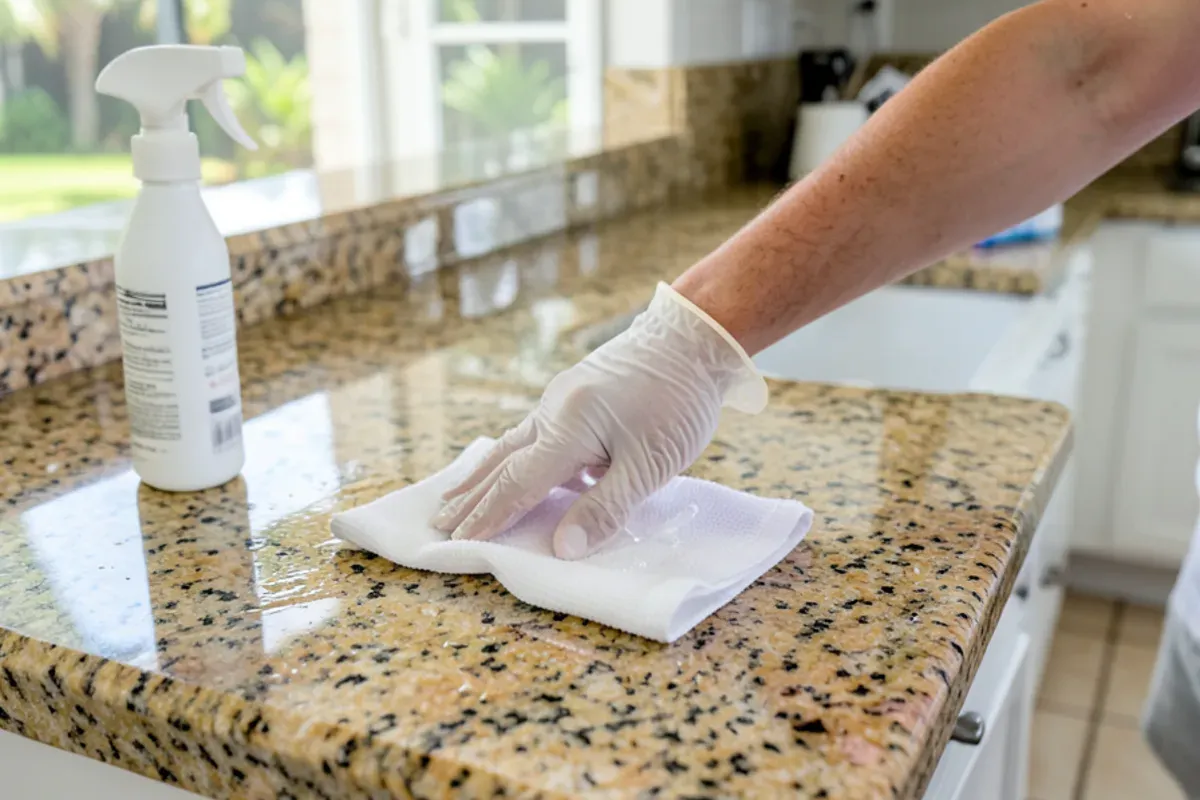
- Clean the counter well and let it dry; follow the sealer label on drying time.
- Apply the sealer evenly with a clean cloth or applicator, working one section at a time.
- Let it sit for the time on the label so it can soak in.
- Wipe off all excess before it dries on the surface; leftover sealer causes a sticky haze.
- Keep the counter dry and lightly used for the cure time the label gives, then repeat the water test.
Call for help if the stone already has a set stain, a haze from an old coating, or dark areas around the sink that do not fade. Our granite sealing visits start by testing and cleaning before anything is applied. For more on choosing and caring for stone, see our granite countertops in Fort Pierce page.
Granite in many newer Port St. Lucie homes was sealed when the builder installed it and may not have been tested since; a quick test tells you where it stands.
What Signs Between Tests Say the Seal Is Wearing?
You do not have to wait for a scheduled test. The counter usually hints first, and any of these is a reason to run the water-drop check that week.
- The stone beside the sink looks darker for a while after you wash dishes
- A faint halo shows around the spot where the oil bottle lives
- Rings appear under a coffee mug or a soap dispenser and take a long time to fade
- Spills that used to sit on the surface now spread into a dark patch
- The busy areas look slightly duller or patchier than the far corners after wiping
Beading water is a good sign, but its absence alone is not proof the seal is gone; some penetrating sealers barely bead even when they work. Darkening is the test that counts.
Is It the Sealer, or Is Water Getting Under the Stone?
Some dark areas have nothing to do with sealer. If water reaches the stone from below or from a joint, it soaks into the back or the edge, and no amount of sealing the top will stop it.
- Look at where the dark area sits. A band along the edge of an undermount sink, around the faucet base or along the backsplash joint points to water coming in from the side.
- Check whether it ever dries. Absorption from a spill fades in hours; a patch fed by a leak stays dark for days.
- Open the sink cabinet and feel the underside of the stone and the cabinet floor for damp wood or drips.
- Look at the caulk where the sink meets the stone and where the splash meets the counter for gaps or black lines.
A failed sink seal or caulk joint is a quick fix compared with a stained slab, so act on it early. A dripping supply line or drain under the sink is plumbing work and should go to a plumber.
From Our Shop: What We Check Before Resealing
Before we reseal, we test the counter in several spots, because a top rarely wears evenly. The strip behind the faucet and the area beside the cooktop usually go first, while the far corner may still bead water. Sealing only what needs it is faster and avoids building residue on stone that is still protected.
We also ask what the counter is cleaned with. If a vinegar spray or a bleach wipe is part of the routine, sealing more often treats the symptom. Switching to a pH-neutral cleaner often stretches the time between resealing more than any sealer brand does.
People also ask which sealer to buy. Penetrating sealers come water-based or solvent-based. Solvent-based products tend to soak into dense stone more readily but need open windows and good airflow while they work; water-based ones have less odor. On most kitchen granites either type does the job when the label is followed, including the wipe-off step; skipping it is where most haze comes from.
Questions We Hear About This
Can you seal granite too often?
Yes, in a sense. If the stone is still sealed, new sealer cannot soak in, so it sits on the surface and dries into a sticky or hazy film. That is why the water test comes first. If you already have haze, a stone-safe cleaner and a little buffing usually removes it; stubborn residue may need a solvent recommended by the sealer maker. We test before applying on every sealing visit.
Does sealing make granite stain-proof?
No. Sealer slows absorption so you have time to wipe a spill before it soaks in; it does not make the stone impervious. Cooking oil, wine or coffee left overnight can still mark a light granite. Wipe spills promptly, especially near the cooktop and sink, and keep oil bottles on a small tray. A sealed stain usually comes out with a poultice, so act early.
Does black granite need sealing?
Often very little. Many black and dark green granites are so dense that water and sealer barely penetrate, and some dark slabs never darken in a water test. Run the test anyway, since some black stones are more porous than they look. Be wary of a black slab that leaves color on a rag with acetone; that points to dye, and dyed stone needs different care.
Do new granite countertops come sealed?
Usually, but check rather than assume. We seal natural stone on the day it is installed. Tops that came with a newly built house may have been sealed by the builder's installer, or not, and nobody may know which product was used. Run a water-drop test near the sink a few weeks after you move in. If it darkens, reseal; if it stays the same, retest in a few months.
The Bottom Line
Seal granite when the stone tells you to, not by the calendar. Test the busy spots a few times a year, clean with pH-neutral products, and reseal only where water darkens the surface. Outdoor and lanai tops deserve more frequent checks in our rainy climate.
If your test shows dark spots that will not fade, or you would rather have it done for you, call us. We'll test, clean and reseal, and tell you honestly if the stone does not need it yet.