
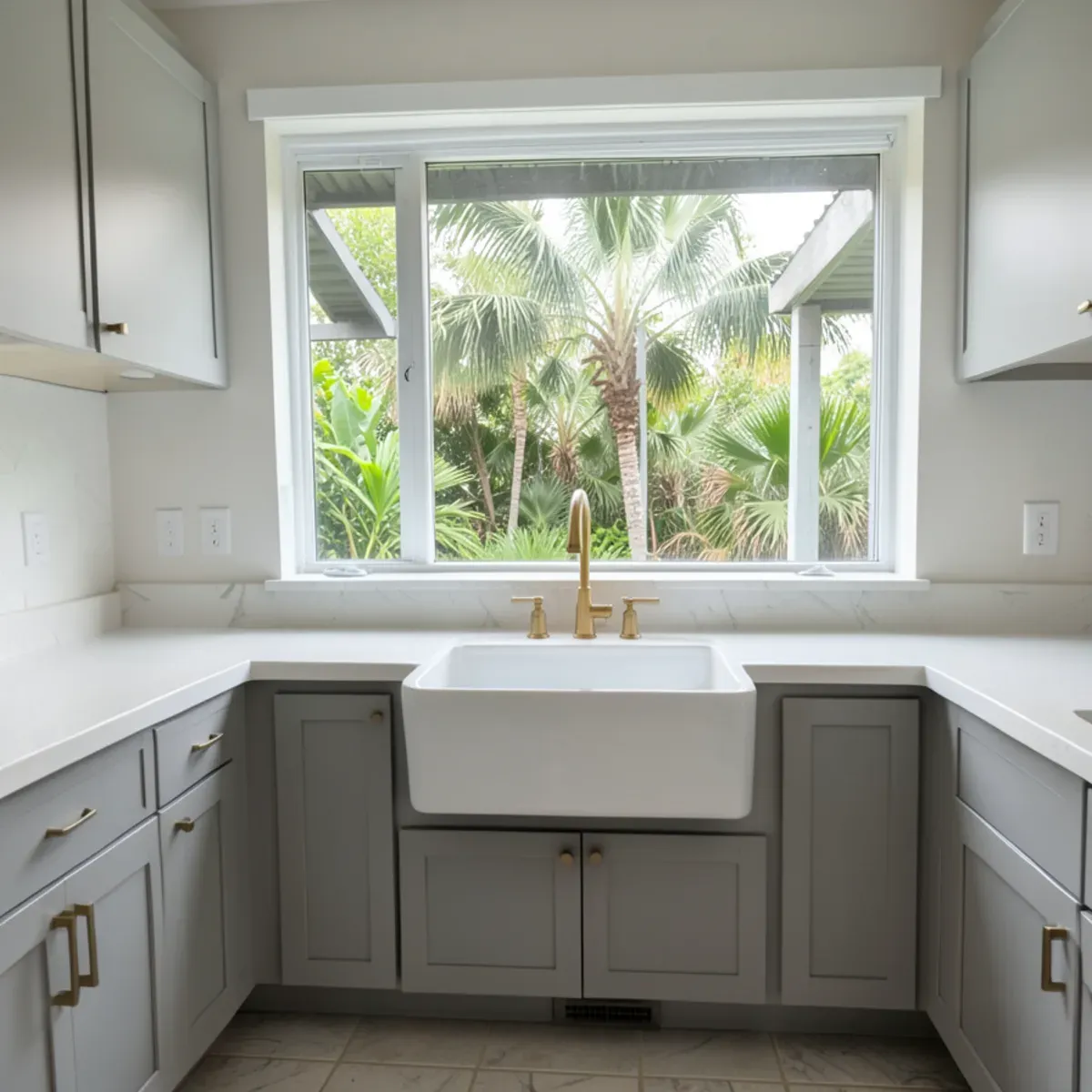
An undermount sink is the simplest match for a stone countertop and fits most standard sink-base cabinets. A farmhouse (apron-front) sink usually needs a modified or purpose-built base. A workstation sink is a long undermount with a ledge for sliding accessories, so it needs a wide cabinet. Choose by cabinet size, how you cook and whether the cabinets are being replaced anyway.
The sink is the hardest-working spot on a countertop and one of the first choices to lock in, because the stone is cut around it. This comparison covers the three styles we are asked about most and what each means for your cabinets, your countertop and your daily cleanup. It is part of our wider guide to kitchen remodeling in Fort Pierce North.
Undermount, Farmhouse and Workstation Sinks Compared
| Undermount | Farmhouse (apron-front) | Workstation | |
|---|---|---|---|
| How it mounts | Hangs below the stone on clips and adhesive | Rests on a support inside the cabinet; front panel exposed | Undermount style with a built-in accessory ledge |
| Cabinet needs | Standard sink base in most cases | Modified or purpose-built base; face frame cut away | Wide sink base, since these bowls run long |
| Countertop cutout | Polished opening sized to the bowl | Cut on three sides; stone stops at the apron | Large opening that leaves narrow strips front and back |
| Cleaning | Crumbs wipe straight into the bowl | Same, plus the exposed apron face | Same as undermount; accessories need rinsing |
| Fits existing cabinets? | Usually | Rarely without cabinet work | Only if the base is wide enough |
| Cost drivers | Sink, cutout, mounting | Sink, cabinet modification, support framing | Sink, accessories, larger cutout |
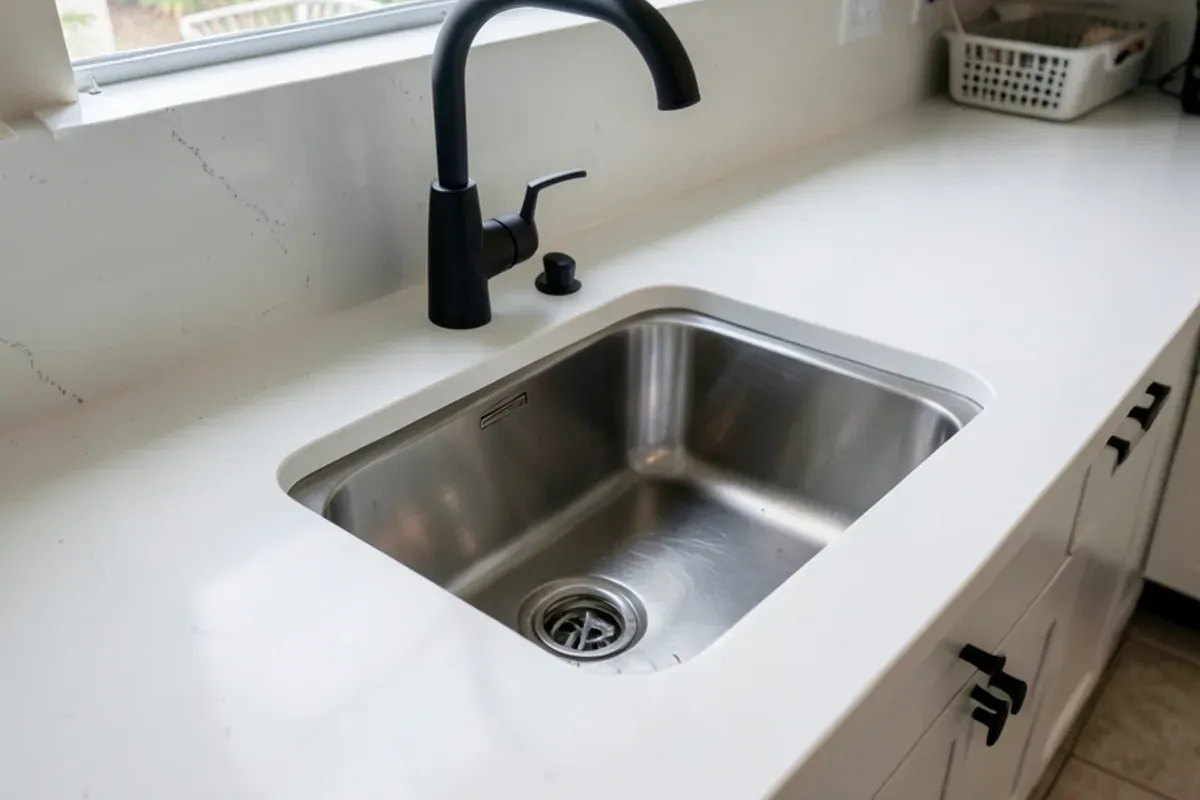
Top-mount (drop-in) sinks also work with stone, but most owners putting in new granite or quartz choose undermount so the polished edge of the cutout shows and no rim sits on the counter to trap grime.
Want a straight answer for your kitchen? Call the shop.
Free in-home estimates · Mon–Fri 7:00–4:30 · weekend estimates by appointment
Why Is an Undermount Sink the Default With Stone?
Stone can be polished inside a cutout, so the sink edge becomes part of the countertop. There is no rim to catch crumbs, and a wet cloth pushes everything into the bowl. The sink fastens to the underside of the stone, which lets it work in the sink base most kitchens already have.
The limits are practical. The bowl has to fit between the cabinet sides, the faucet holes are drilled in the stone itself, and a sink too wide for the base cannot be forced in. Our kitchen sink installation page explains how we mount and seal undermounts during a countertop install.
Can a Farmhouse Sink Go Into Existing Cabinets?
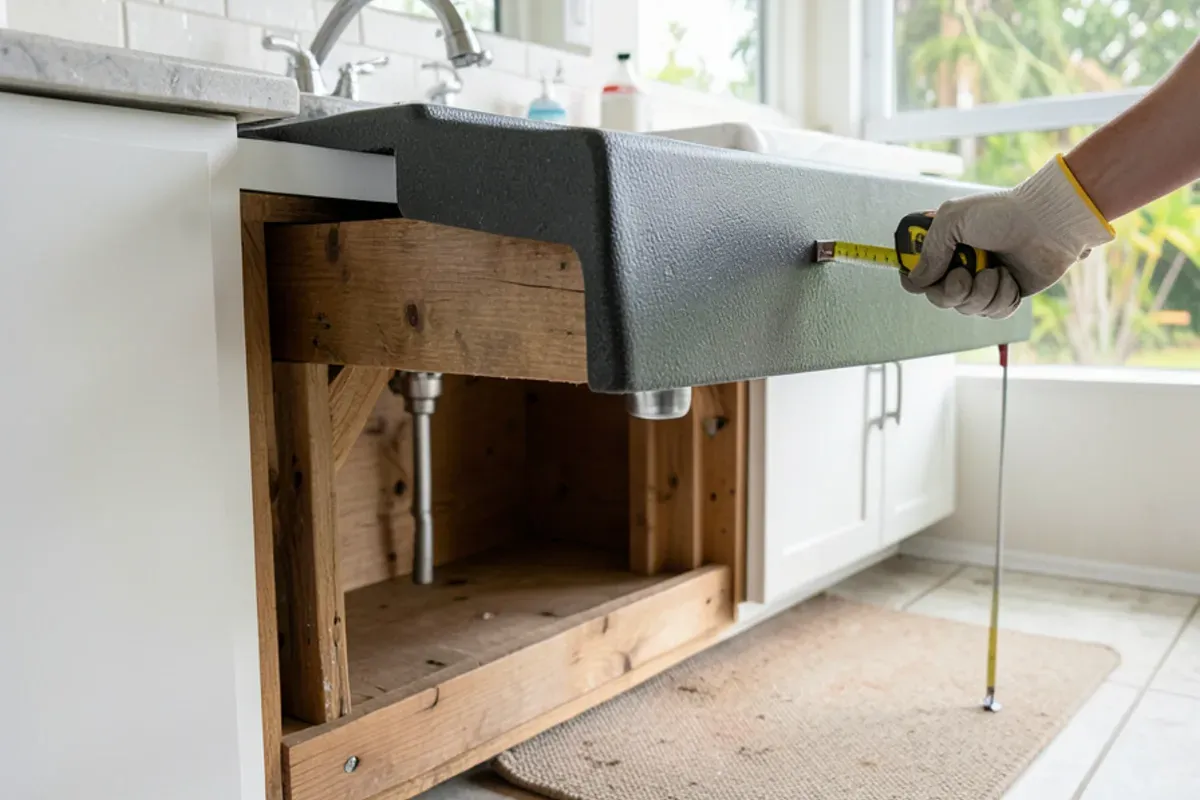
Sometimes, but it is cabinet work, not only countertop work. The apron sits flush with or slightly proud of the cabinet face, so the face frame and false drawer front of a standard sink base are cut away and a platform is built inside to carry the sink. Fireclay and cast-iron farmhouse sinks are heavy, and that weight rests on the cabinet, not the stone.
- Check that the sink's width suits the cabinet, with room left for the support framing.
- Make sure the apron height lines up sensibly with the neighboring drawer fronts.
- Confirm the dishwasher beside it still opens cleanly past the apron.
When cabinets are being replaced anyway, ordering a farmhouse base designed for the sink is the cleaner path.
Is a Workstation Sink Worth It on a Stone Countertop?
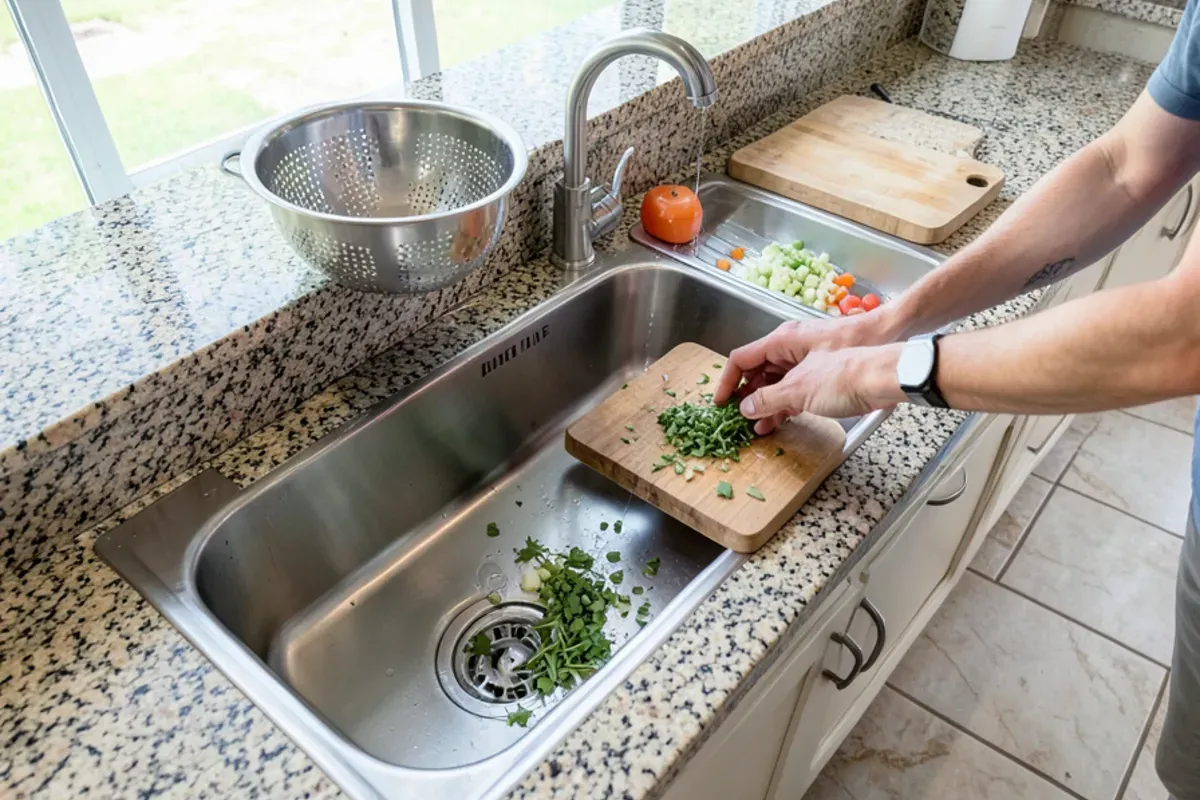
A workstation sink is a long, deep undermount with a ledge just below the counter line that holds sliding cutting boards, colanders and drying racks. Owners who cook a lot like that it turns the sink into prep space. Before choosing one, check two things:
- Width. These sinks often run 30 inches or more, which calls for a wide sink base.
- Stone strips. A long cutout leaves narrow sections of stone in front of and behind the bowl. Those strips are handled carefully in fabrication and transport, and no seam is placed beside them.
In newer homes in places like Port St. Lucie, where a 33- or 36-inch sink base is common, a workstation sink often drops in without any cabinet changes.
Does Sink Material Change How It Mounts Under Stone?
Style decides the cabinet; material decides the weight and how the sink feels to live with. The three materials we see most each sit differently under a granite or quartz top:
| Material | How it is carried | Day to day |
|---|---|---|
| Stainless steel | Light enough to hang from clips anchored into the underside of the stone, with a sealant bead at the rim | Forgiving of dropped dishes; thin gauges ring and dent, so ask about a heavier gauge and sound pads |
| Granite composite | Heavier than stainless; clips plus a support rail or brackets inside the base | Quiet and matte; pale colors can pick up coffee and tomato stains over time |
| Fireclay or cast iron | Too heavy to hang; rests on a frame built inside the cabinet, with the stone bearing on the rim | Glossy and easy to wipe; a heavy pot knocked against the edge can chip the glaze |
Weight matters most on older cabinets. In a 1980s Fort Pierce kitchen, the sink base is often the box that has absorbed years of small drips, so before recommending fireclay or cast iron we press on its floor and sides. A soft panel there means the base gets replaced before a heavy sink goes in, whatever style you choose.
Which Sink Fits Your Kitchen? Five Questions to Answer First
Work through these in order before you shop. The first two usually narrow the choice to one or two styles.
- How wide is the sink base inside? Measure between the cabinet side panels, not the door opening; the bowl and its mounting hardware have to fit in that space.
- Are the cabinets staying? If they are, an undermount or a workstation sink that suits the base keeps the job to stone work. A farmhouse sink adds cabinet work.
- How do you wash up? Roasting pans and sheet trays favor one large bowl. Owners who hand-wash while something soaks often prefer a double bowl or a workstation ledge.
- Where does the dishwasher sit? Its door has to swing past an apron front, and its drain hose needs a clear path to the sink's drain.
- Is the sink staying in its spot? Keeping the location keeps the project simple; a new location brings in licensed plumbing, as the next section explains.
What Changes When the Sink Moves?
Swapping the sink style in the same spot is the simple version. St. Lucie County's exemption for sink replacement applies only to a sink that keeps its current position (St. Lucie County Government), so moving the sink to an island or another wall turns into licensed plumbing work with a permit. Within the City of Fort Pierce, a plumbing permit is a separate application from the building permit, per the City of Fort Pierce.
From Our Shop: Bring the Sink to the Template, Not the Spec Sheet
Manufacturers publish cutout templates, but bowls of the same nominal size can differ in corner radius, flange width and depth. That is why we ask for the actual sink and faucet to be in the house when we template. We set the sink in place, trace its true outline and plan the faucet holes around the real hardware.
It also lets us check the sink against the cabinet before anything is cut. If a farmhouse apron will not clear the face frame or a workstation sink is too long for the base, we would rather learn that with a tape measure than with a finished slab.
One more choice owners rarely hear about until the template is the reveal: how the stone edge meets the bowl. With a positive reveal the cutout sits back slightly and a thin line of sink rim shows. With a zero reveal the stone stops flush with the bowl wall. With a negative reveal the stone overhangs the bowl a little. On stainless we usually suggest a small positive or a zero reveal, because a negative reveal leaves a ledge under the stone that is hard to see and harder to clean. It is a small decision, but it has to be made before the cutout is cut.
Questions We Hear About This
Which sink style is easiest to keep clean with a granite or quartz top?
An undermount or workstation sink, because no rim sits on the counter. Crumbs and water wipe straight into the bowl, and the polished cutout edge stays visible. Drop-in sinks leave a lip where grime collects. A farmhouse sink cleans like an undermount at the counter line, though its exposed apron needs a wipe too.
Does a farmhouse sink cost more to install than an undermount?
Usually, yes. The sink itself tends to cost more, and the cabinet has to be modified or replaced to carry it, which adds labor. The stone cutout is comparable. If you are already replacing cabinets, the gap narrows because the base can be ordered to suit the sink from the start.
Can a workstation sink go in a kitchen island?
Yes, if the island has room for a wide sink base and a route for supply and drain lines. Adding a sink to an island that never had one is new plumbing, which means a licensed plumber and a permit. An island sink also needs enough counter on each side to work comfortably, so we check spacing at the measuring visit.
Should we pick a single bowl or a double bowl under stone?
It depends on how you wash up. A single large bowl handles roasting pans and sheet trays, and most workstation sinks are single bowls. A double bowl lets one side soak while the other drains, which suits owners who hand-wash often. Both mount the same way under granite or quartz; the deciding measurement is the inside width of your sink base.
The Bottom Line
For most stone kitchens, an undermount is the easy fit, a workstation sink is an undermount with more to offer when the base is wide enough, and a farmhouse sink is a cabinet decision as much as a sink decision.
Call for a free estimate at home, and have the sink you are considering on hand, or its dimensions, and we will check it against your cabinets and price the cutout in writing.